Cosmic Interruptions: How Solar Events Reshape Delivery Networks for Global Athletic Telecasts
Written by Avery Bauer · Jul 29, 2026
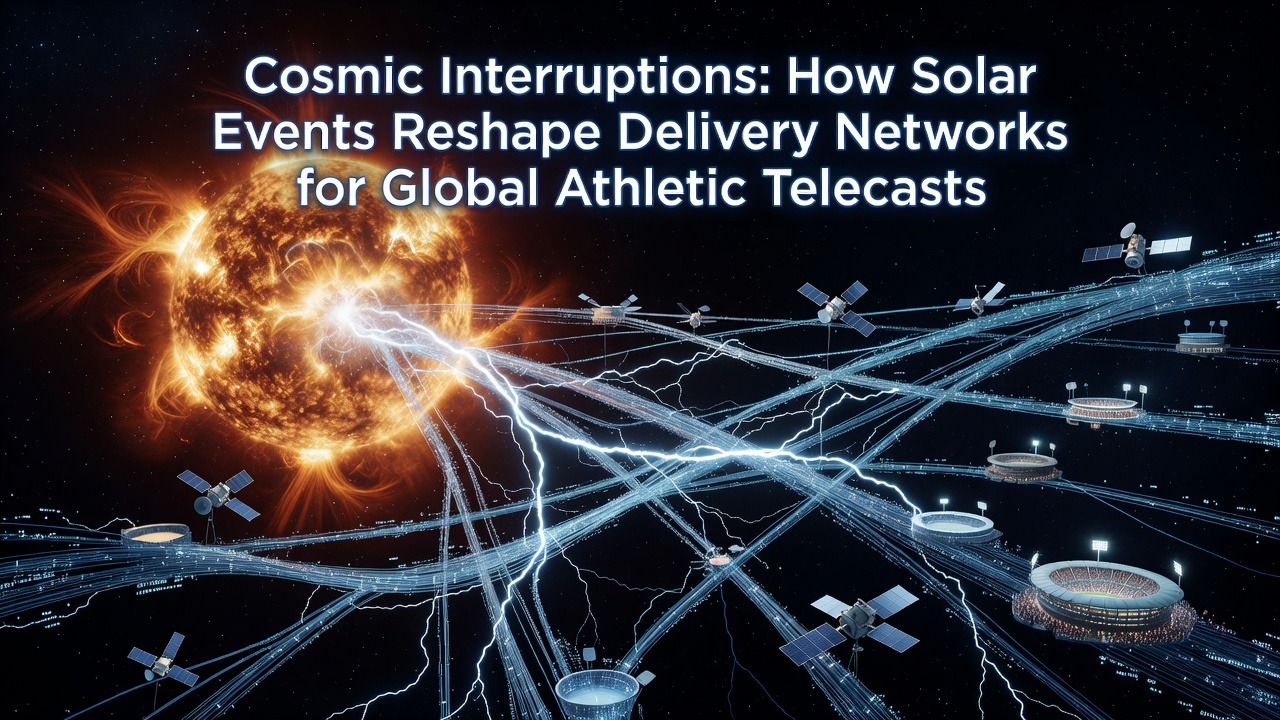
Cosmic Interruptions: How Solar Events Reshape Delivery Networks for Global Athletic Telecasts
Researchers track solar cycles that reach heightened activity levels around 2025 and into 2026, periods when coronal mass ejections and solar flares increase the likelihood of geomagnetic disturbances that interfere with satellite signals carrying live athletic events across continents. Data from monitoring agencies show these events produce sudden ionospheric disturbances capable of degrading high-frequency communications and Ku-band satellite transmissions used by global broadcasters.
Solar Activity Patterns and Communication Pathways
Observers note that solar maximum phases occur roughly every eleven years, with the current cycle projected to peak during mid-2025 through July 2026, according to records maintained by space weather centers. During such intervals, bursts of charged particles reach Earth and compress the magnetosphere, which in turn alters radio propagation paths relied upon by ground stations feeding content to orbiting satellites. Networks distributing soccer matches, basketball tournaments, and multi-sport packages therefore encounter brief outages or quality drops when uplink stations lose lock on transponders.
Studies compiled by the European Space Agency document cases where solar radio bursts directly overlap with downlink frequencies, creating noise that interrupts the continuous data streams required for real-time score updates and video encoding. Delivery networks respond by switching to alternate satellite paths or terrestrial fiber links, yet these reroutes require advance coordination among uplink operators, satellite providers, and rights holders.
Effects on Satellite-Dependent Sports Broadcasts
Global athletic telecasts depend on geostationary satellites for wide-area coverage, particularly when events originate in remote venues or span multiple time zones. When solar protons penetrate the atmosphere, they elevate electron density in the ionosphere and produce scintillation that fades signal strength, a phenomenon recorded during previous cycles by ground-based observatories. Broadcasters in regions such as North America, Europe, and Asia-Pacific report momentary blackouts lasting from seconds to several minutes, sufficient to disrupt highlight packages and replay libraries that rely on synchronized metadata.
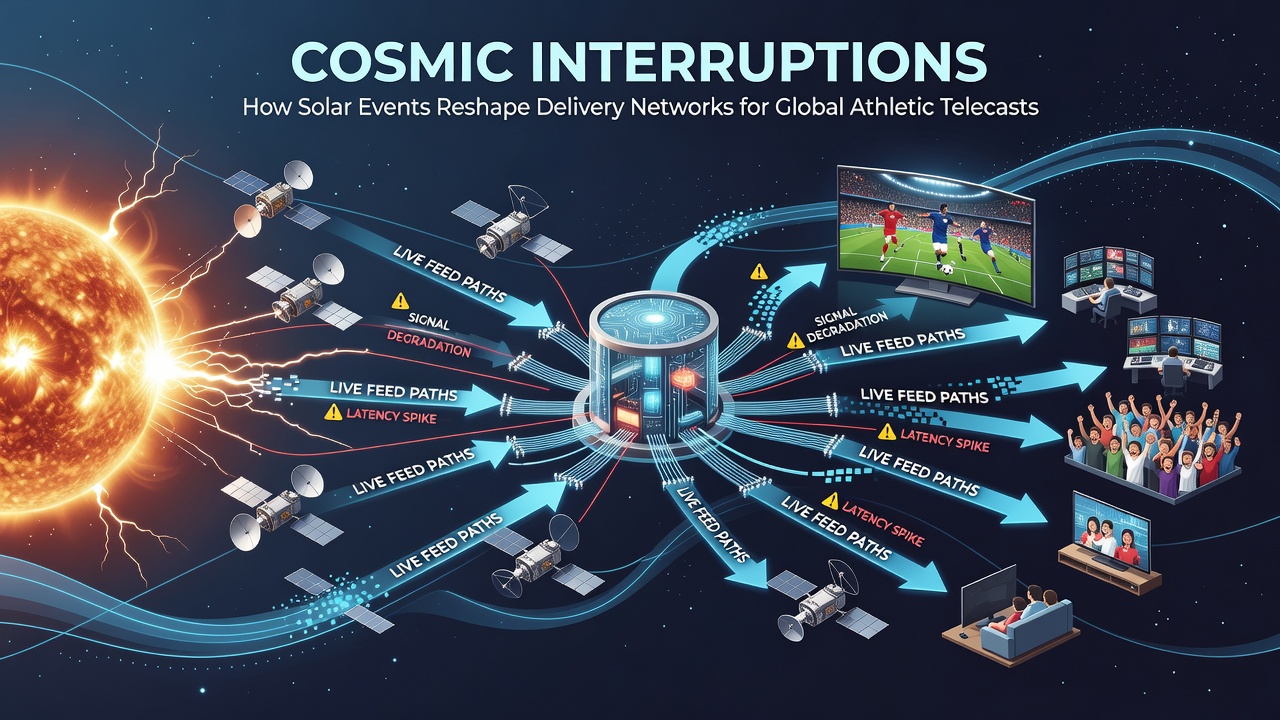
Industry reports from the Satellite Industry Association indicate that operators maintain redundant transponders and predictive models to anticipate disruptions, allowing them to pre-position content on edge servers before forecasted solar activity windows. In July 2026, for instance, planners anticipate scheduling critical basketball doubleheaders and soccer qualifiers during lower-risk periods or shifting select feeds to fiber routes where available. Such adjustments preserve continuity for viewers accessing streams through adaptive platforms that automatically select the least-affected pathway.
Mitigation Strategies and Network Adaptations
Technical teams employ space-weather forecasting services operated by agencies including NOAA in the United States and the Australian Space Weather Forecasting Centre to issue alerts days in advance, enabling broadcasters to adjust encoding parameters and buffer strategies. These forecasts incorporate measurements of solar flux and geomagnetic K-index values that correlate with signal degradation thresholds. When alerts reach moderate levels, delivery networks activate diversity reception techniques that combine signals from multiple orbital slots, reducing the impact of localized scintillation.
Research published by university laboratories in Canada and Japan demonstrates that machine-learning models trained on historical telemetry data can predict outage durations with increasing accuracy, allowing rights holders to pre-load alternative highlight segments or switch to lower-resolution streams during peak disturbance intervals. Community archives and shared replay libraries similarly benefit when operators tag affected segments for later restoration once conditions stabilize.
Case Examples from Recent Cycles
During elevated activity in prior cycles, operators documented interruptions to international basketball tournaments and soccer qualifiers when solar flares coincided with prime-time windows in Europe and Asia. One documented instance involved a multi-continent feed that experienced repeated dropouts, prompting a temporary reroute through undersea cable networks coordinated between North American and European hubs. Observers recorded similar patterns during late-evening fixtures where delayed announcements of start times compounded scheduling pressures on streaming ecosystems.
Figures released by satellite operators reveal that proactive handovers between primary and backup satellites limited viewer impact to under two percent of total transmission time across monitored events. These statistics underscore the value of integrated monitoring systems that link space-weather data directly to network operations centers responsible for athletic telecast distribution.
Conclusion
Space-weather events continue to influence the reliability of satellite pathways that underpin worldwide delivery of athletic programming. Organizations monitoring solar cycles supply advance notice that allows operators to implement rerouting protocols and maintain service continuity through July 2026 and beyond. Continued refinement of predictive tools and diversified infrastructure supports consistent access to live contests and associated digital archives even amid fluctuating solar conditions.