Mapping Weather Forecasts to Dynamic Broadcast Windows in Outdoor Team Sports
Written by Avery Bauer · Aug 19, 2026
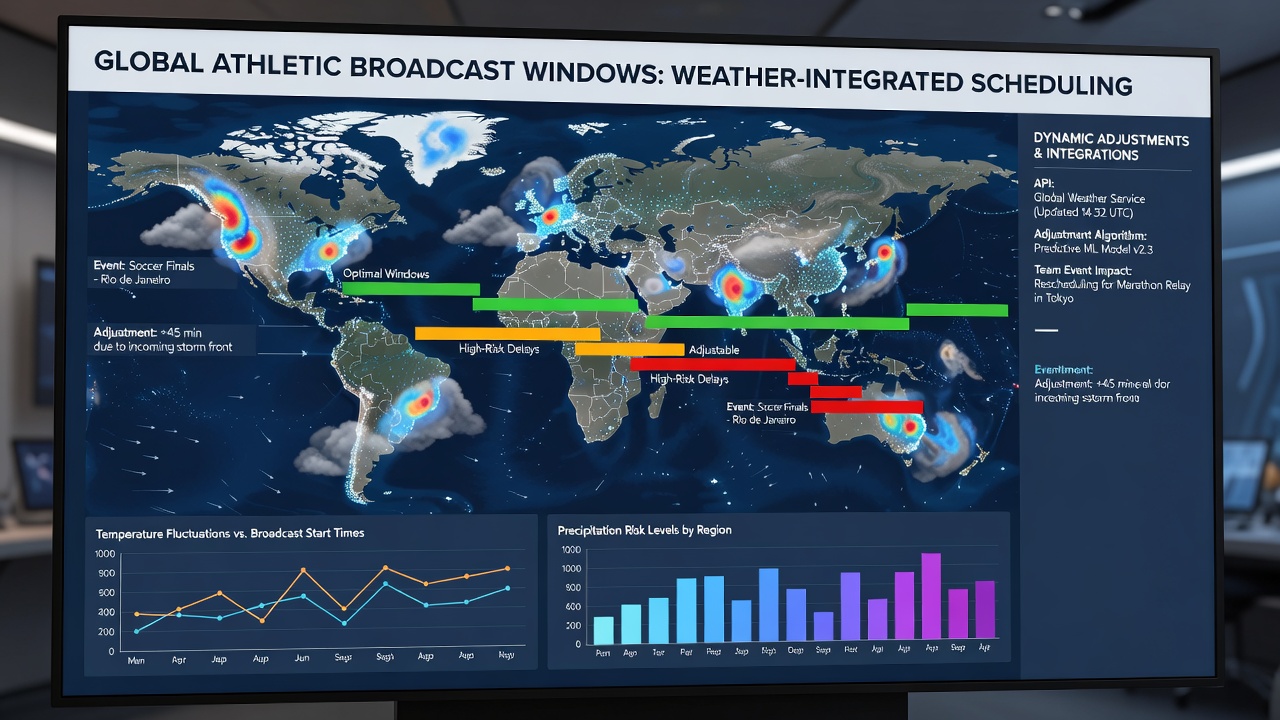
Mapping Weather Forecasts to Dynamic Broadcast Windows in Outdoor Team Sports
Weather forecast integrations now drive scheduling decisions for outdoor team events across multiple continents, where rain, wind, and temperature shifts force broadcasters to alter transmission slots in real time. Organizations collect data from satellite networks and ground stations then feed those readings into algorithms that recalculate available airtime for soccer matches, baseball games, and rugby fixtures. These systems operate continuously because a single storm cell can shift a start time by several hours and ripple through coordinated international feeds.
How Forecast Data Enters Broadcast Planning Cycles
Teams responsible for global athletic transmissions receive hourly updates from meteorological services that track precipitation probability, wind speeds above 40 kilometers per hour, and lightning risk within a 15-kilometer radius of venues. In practice this means schedulers at networks covering Major League Baseball or European football leagues review model outputs from sources such as the National Oceanic and Atmospheric Administration alongside regional partners. Adjustments occur when thresholds are crossed; for instance, heavy rain warnings issued 48 hours ahead prompt moves from evening prime-time slots to earlier afternoon windows in distant time zones.
August 2026 preparations illustrate the pattern. Organizers of several international tournaments already test integrated platforms that combine venue-specific radar with satellite-derived humidity readings, allowing producers to lock alternate broadcast windows before teams travel. Data shows that events held in subtropical regions experience the highest frequency of last-minute changes, while temperate-zone fixtures see fewer disruptions yet still require contingency planning for heat advisories.
Dynamic Adjustments Across Time Zones and Leagues
Broadcast windows rarely exist in isolation. A delay at a stadium in South America immediately affects live feeds destined for Asia and Europe, where secondary windows must open without overlapping other scheduled programming. Software platforms now map these constraints by layering weather probability layers onto calendar grids that list every participating league. When forecasters raise a wind alert for an Australian cricket ground, the system flags downstream conflicts with concurrent North American baseball games and proposes new start times that satisfy both rights holders and local regulators.

Research from institutions tracking multi-league calendars indicates that dynamic rescheduling reduces viewer drop-off by preserving access to at least one clean transmission window per event. Observers note that leagues in the Southern Hemisphere coordinate most closely with Northern Hemisphere partners during their respective off-seasons, because weather volatility peaks during transition months. The result is a rolling set of revised schedules published through official channels and mirrored on aggregator sites that fans consult before travel or viewing commitments.
Technical Components Behind the Integration
Modern systems rely on application programming interfaces that pull real-time observations every fifteen minutes and push revised recommendations to production teams. These interfaces combine ensemble forecast models, which average multiple simulations, with venue-specific historical performance data. A lightning detection network, for example, supplies strike counts that trigger automatic halts; the broadcast software then calculates the shortest delay that still fits remaining daylight or artificial lighting restrictions. European meteorological agencies and Australian Bureau of Meteorology feeds both contribute to the same dashboard used by rights holders operating across hemispheres.
Case examples include a 2025 series of rugby matches in New Zealand where gust warnings prompted an earlier kickoff that preserved the full international feed for European audiences. Similar logic applied during North American soccer tournaments when afternoon thunderstorms forced morning starts, shifting the corresponding Asian broadcast from late night to early evening. Each change followed predefined decision trees that balance safety, contractual obligations, and audience metrics tracked by the platforms themselves.
Future Refinements and Data Sharing Agreements
Agreements between sports governing bodies and national weather services continue to expand data-sharing protocols. These pacts specify latency limits on forecast delivery and standardized formats for severe-weather alerts so that adjustments propagate uniformly. Academic studies examining transmission reliability across continents report measurable gains in schedule stability when such integrations reach at least four update cycles per day. As August 2026 events approach, additional layers incorporating climate-trend projections are under evaluation, though current operations still prioritize short-range accuracy over seasonal outlooks.
Conclusion
Weather forecast integrations have become standard infrastructure for managing broadcast windows of outdoor team events worldwide. The combination of continuous data feeds, algorithmic recalculation, and cross-zone coordination allows producers to respond to changing conditions while maintaining access for global audiences. Systems tested during recent seasons and refined ahead of 2026 tournaments demonstrate that timely adjustments rest on precise meteorological inputs rather than manual overrides alone.